자율주행 캐디 서비스 로봇 (Capstone)
자율주행 캐디 서비스 로봇 (Capstone)
Autonomous Caddy Service Robot (Capstone)
개요
골프장에서 사람 캐디 없이 자율 라운딩을 지원하는 로봇을 개발한 캡스톤 디자인 프로젝트(공식 작품명 “비대면 캐디 서비스 로봇”). 4인 팀의 리더로서 ROS 기반 시스템 설계부터 실차 프로토타입 제작까지 이끌었고, 이 작품으로 제17회 광운 ICT 작품 전시회(KWIX) 최우수상(총장상) 을 수상.
🎬 시연 영상: Final Demo · 장애물 회피 · ODE 시뮬레이션
문제
사람 캐디 없이 골프백을 옮기려면, 로봇이 실외 환경에서 사용자를 놓치지 않고 따라가면서 이동 중 마주치는 정적·동적 장애물을 동시에 회피 필요. 사용자 추종과 장애물 회피는 진행 방향이 서로 충돌할 수 있는 목표라서, 두 동작을 하나의 주행 알고리즘으로 결합하는 것이 핵심 과제. 또한 실외 주행에서는 기준이 서로 다른 GPS·IMU 좌표계를 일관되게 정렬해야 주행이 안정됨.
역할
팀 리더로서 ROS 기반 시스템의 설계와 구현 총괄. 자율주행·추종 알고리즘과 GPS·IMU·2D LiDAR 인지 파이프라인, 전원·제어 회로의 설계·통합을 직접 담당.
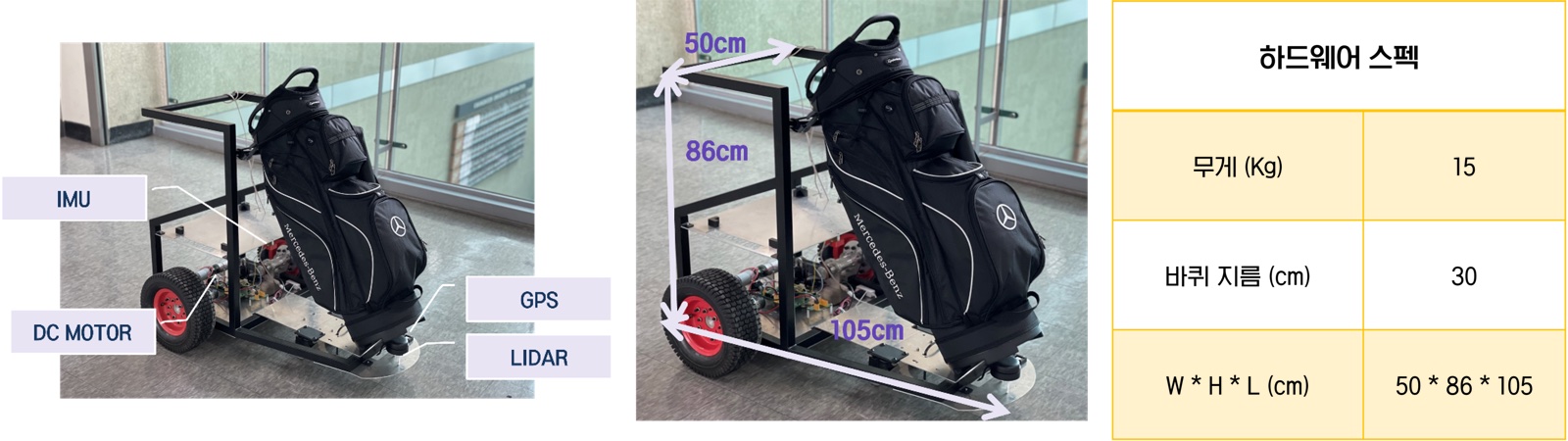 실차 프로토타입 하드웨어 — 50×86×105cm(W×H×L), 15kg, 바퀴 지름 30cm
핵심 기여
- 사용자 리모컨의 GPS 위치로 목표점을 생성하고, 사용자 방향 인력(attractive force)과 장애물 척력(repulsive force)을 결합한 Potential Field 주행 알고리즘으로 사용자 추종과 동적·정적 장애물 회피를 동시에 구현
- GPS·IMU·2D LiDAR를 통합한 인지 파이프라인을 구축하고, IMU 기반 heading 추정과 북쪽 기준 좌표계 정규화로 주행 안정성 확보
- ODE(Open Dynamics Engine) 시뮬레이션 환경에서 알고리즘을 선행 검증한 뒤 실차 주행에 적용
- 전원·제어 회로를 직접 설계·통합해 실외 주행이 가능한 로봇 플랫폼 완성
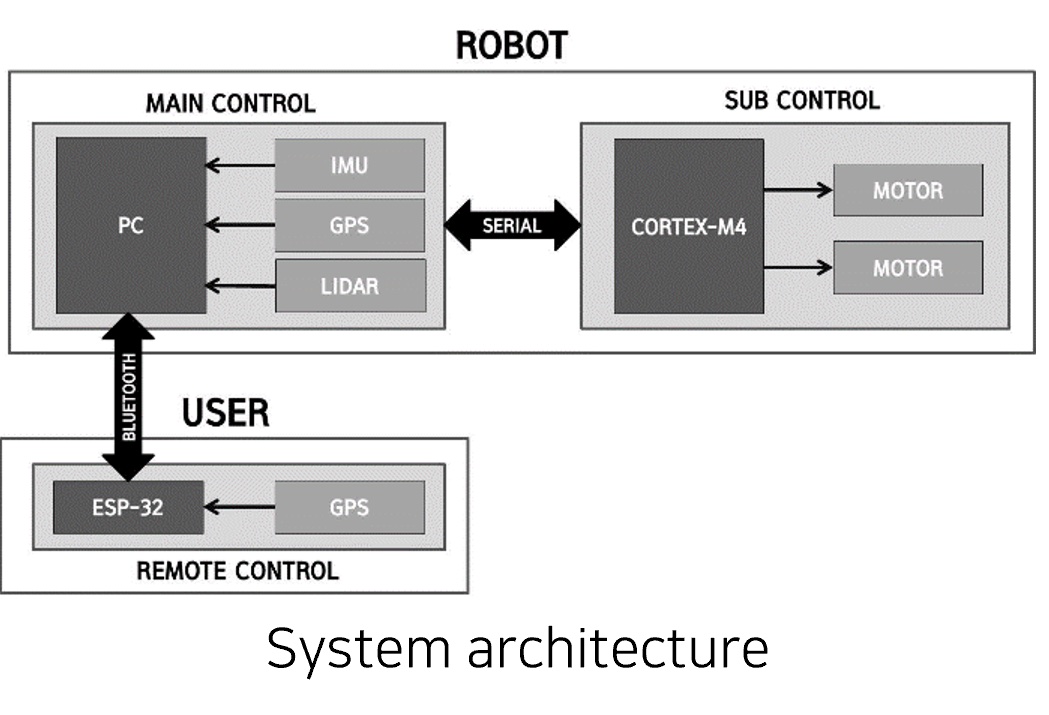 시스템 아키텍처 — 메인 PC(ROS)와 CORTEX-M4 서브 컨트롤러를 시리얼로 연결하고, 사용자 리모컨(ESP-32·GPS)이 블루투스로 목표 위치 전달
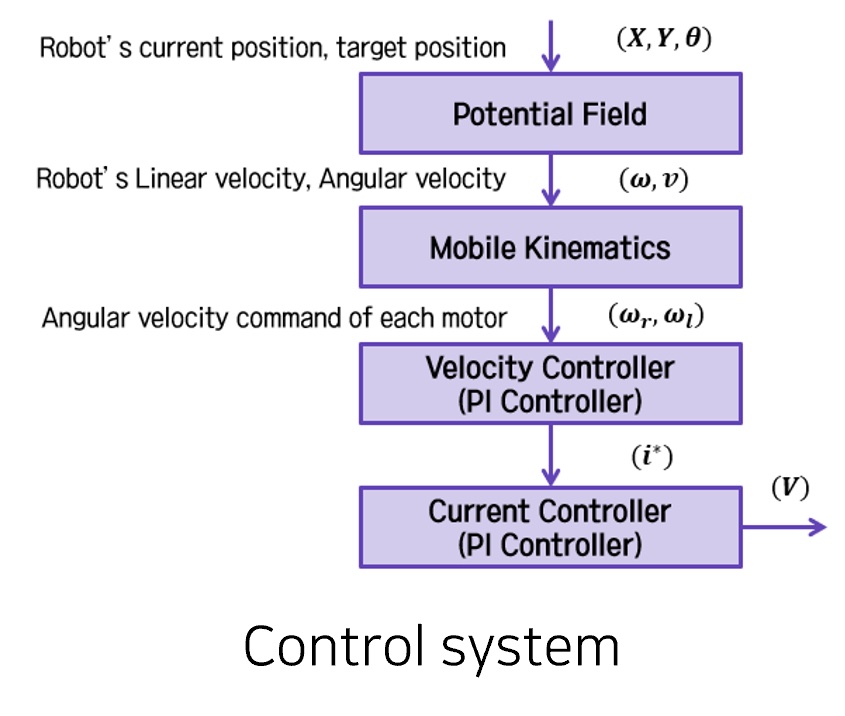 제어 구조 — Potential Field가 출력한 속도 명령을 Mobile Kinematics로 바퀴별 각속도로 변환하고, 속도·전류 PI 제어기로 모터 구동
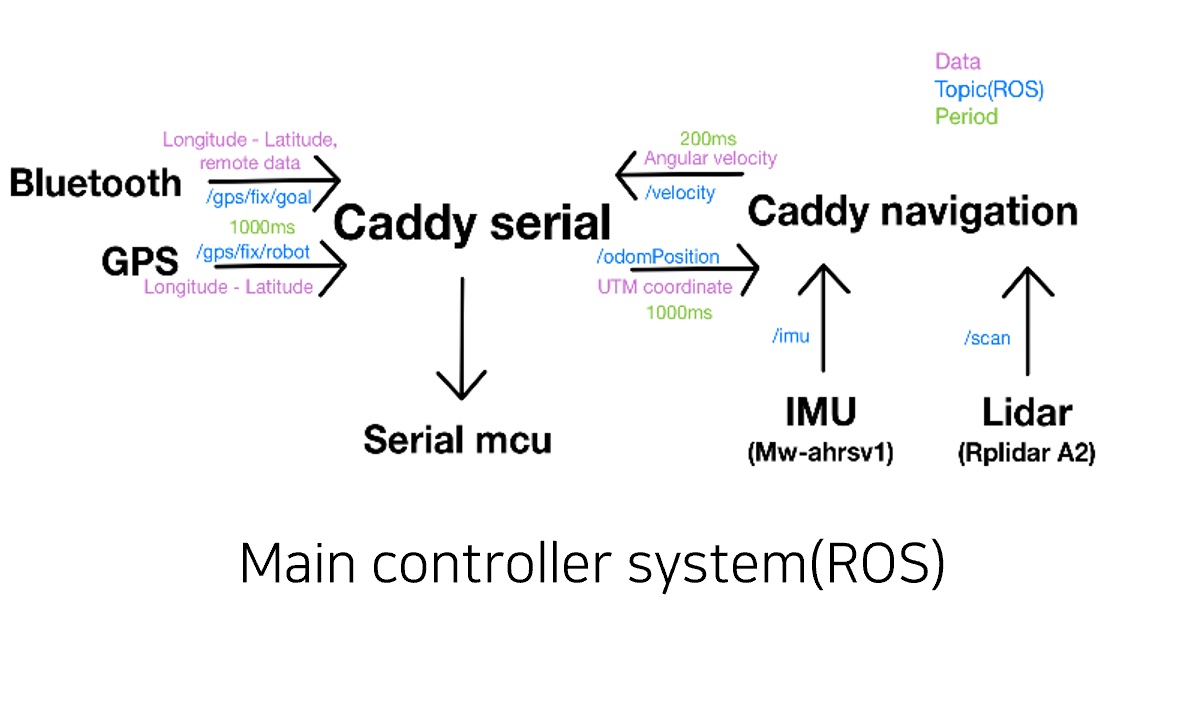 ROS 노드 구성 — Caddy serial 노드가 GPS·블루투스 입력을 받아 MCU와 통신하고, Caddy navigation 노드가 IMU·LiDAR 입력으로 속도 명령 생성
결과
ODE 시뮬레이션으로 정적·동적 장애물 회피를 선행 검증한 뒤, 50×86×105cm·15kg 실차 프로토타입을 제작해 실외 환경에서 GPS 사용자 추종·장애물 회피 주행 시연(시연 영상 3편).
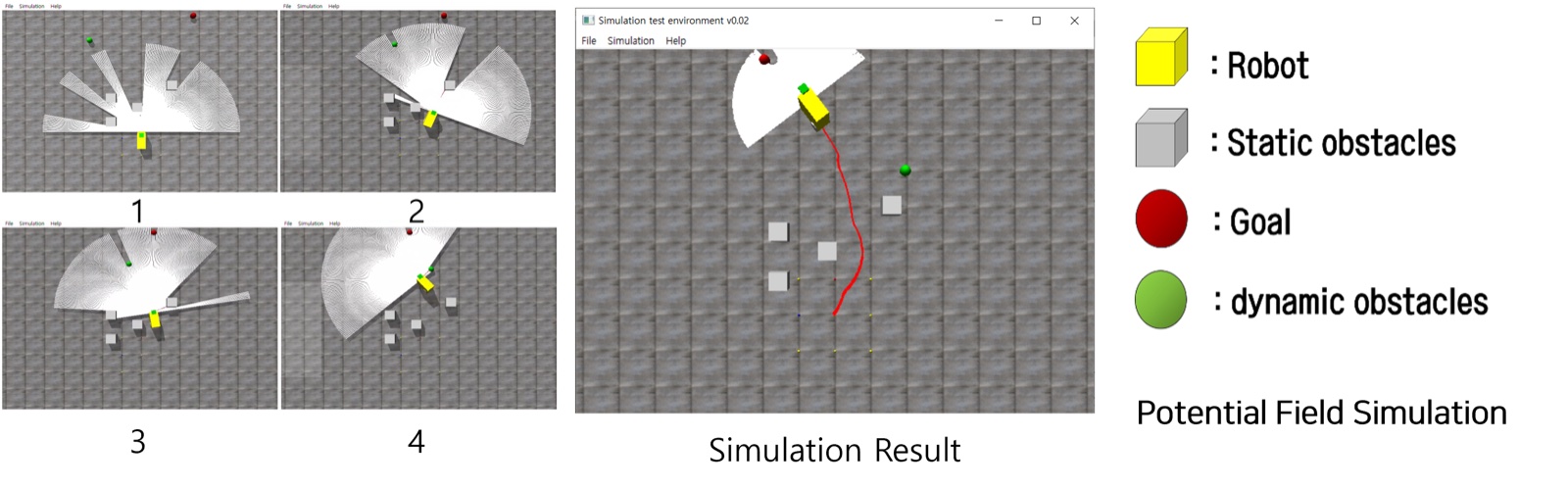 ODE 기반 Potential Field 시뮬레이션 — 정적·동적 장애물을 회피하며 목표점에 도달하는 주행 경로
수상

Overview
Capstone design project that developed a robot supporting autonomous golf rounds without a human caddy (official entry title: “Contactless Caddy Service Robot”). Led a four-member team from ROS-based system design through building the real-vehicle prototype; the work won the Excellence Award (University President’s Award) at the 17th Kwangwoon ICT Exhibition (KWIX).
🎬 Demo videos: Final Demo · Obstacle Avoidance · ODE Simulation
Problem
Carrying a golf bag without a human caddy requires the robot to follow the user in an outdoor environment without losing them, while simultaneously avoiding the static and dynamic obstacles encountered along the way. User-following and obstacle avoidance can pull the heading in conflicting directions, so combining the two behaviors into a single driving algorithm was the core challenge. Outdoor driving also demands consistent alignment of the GPS and IMU coordinate frames, which use different references, for stable driving.
Role
As team leader, oversaw the design and implementation of the ROS-based system. Directly responsible for the autonomous-driving/following algorithms, the GPS/IMU/2D LiDAR perception pipeline, and the design and integration of the power/control circuits.
Real-vehicle prototype hardware — 50×86×105cm (W×H×L), 15kg, 30cm wheel diameter
Key Contributions
- Generated target points from the user’s remote-control GPS position and implemented simultaneous user-following and dynamic/static obstacle avoidance with a Potential Field driving algorithm combining an attractive force toward the user and a repulsive force from obstacles
- Built an integrated GPS/IMU/2D LiDAR perception pipeline; secured driving stability with IMU-based heading estimation and north-referenced coordinate normalization
- Validated the algorithm in an ODE (Open Dynamics Engine) simulation environment before applying it to real-vehicle driving
- Designed and integrated the power/control circuits, completing a robot platform capable of outdoor driving
System architecture — the main PC (ROS) and the CORTEX-M4 sub-controller are connected over serial, and the user remote control (ESP-32, GPS) sends the target position over Bluetooth
Control structure — velocity commands from the Potential Field are converted to per-wheel angular velocities via Mobile Kinematics, and the motors are driven by velocity and current PI controllers
ROS node layout — the Caddy serial node receives GPS/Bluetooth input and communicates with the MCU, while the Caddy navigation node generates velocity commands from IMU/LiDAR input
Results
Validated static/dynamic obstacle avoidance in ODE simulation first, then built a 50×86×105cm, 15kg real-vehicle prototype and demonstrated GPS user-following and obstacle-avoidance driving in an outdoor environment (three demo videos).
ODE-based Potential Field simulation — driving path reaching the target point while avoiding static and dynamic obstacles
Awards