멀티 UAV 편대 제어 (NRF 안티드론 스웜)
멀티 UAV 편대 제어 (NRF 안티드론 스웜)
한국연구재단(NRF)의 “불법드론 무력화를 위한 인공지능 기반의 협력적 자율주행 스웜 안티드론 시스템 개발” 과제에서 멀티 UAV 편대 제어(Multi-UAV Formation Control)를 연구. 다수의 무인항공기(UAV)가 중앙 통신 없이 스스로 포메이션(Formation)을 유지하는 분산 제어기를 개발해, 1대의 Virtual Leader(실기체가 아닌 가상 기준점)와 4대의 팔로워 구성에서 포메이션 오차 ±0.2m 이하를 확인했고, S자형 경로 추종 실험에서는 기존 알고리즘 대비 위치 오차(MSE) 약 61% 감소를 달성.
문제
안티드론 스웜은 여러 대의 UAV가 팀을 이뤄 불법드론에 협력적으로 대응하는 시스템. 어려움은 다수의 기체가 중앙 통신 없이, 이웃 기체와의 상대 벡터·거리 정보만으로 포메이션을 유지해야 한다는 점. 비행이 길어질수록 센서 오차가 누적되고 기체 동역학의 비선형성까지 겹치는 상황에서, 포메이션 유지와 충돌 회피를 동시에 만족하는 제어기가 필요.
역할
고려대학교 Advanced Control System Lab 석사과정에서 참여한 과제로, Multi-UAV 협력 제어·충돌 회피 알고리즘 개발과 검증용 하드웨어 제작을 담당.
핵심 기여
- 최근 일정 구간(window)의 데이터만 학습에 사용하는 Finite-Memory(유한 메모리) 방식으로 분산 제어기를 설계해, 오차 누적과 비선형성에 강인한 제어 성능을 확보.
- 팔로워 간의 연결 관계(상대 거리·각도)를 그래프 기반 상호위상 모델(Graph Model)로 협력 항법에 반영해, 동적 포메이션의 안정성을 보장.
- 팔로워들이 실기체 리더가 아닌 공통의 가상 목표점(Virtual Leader)을 추종하는 구조로, 중앙 통신 없는 분산 협력 제어를 실현.
- 포메이션 비행 중 장애물을 피하는 충돌 회피 알고리즘을 개발하고 MATLAB 시뮬레이션으로 검증.
- 기체 간 상대 거리를 측정하는 UWB와 IMU를 탑재한 Pixhawk(오픈소스 비행 컨트롤러) 기반 헥사콥터를 제작하고, ROS 환경에서 알고리즘을 실기체로 검증.
결과
알고리즘은 MATLAB 시뮬레이션으로 먼저 검증. 장애물 회피와 Virtual Leader 추종 포메이션 유지가 의도대로 동작함을 확인한 뒤 실기체 실험으로 확장.
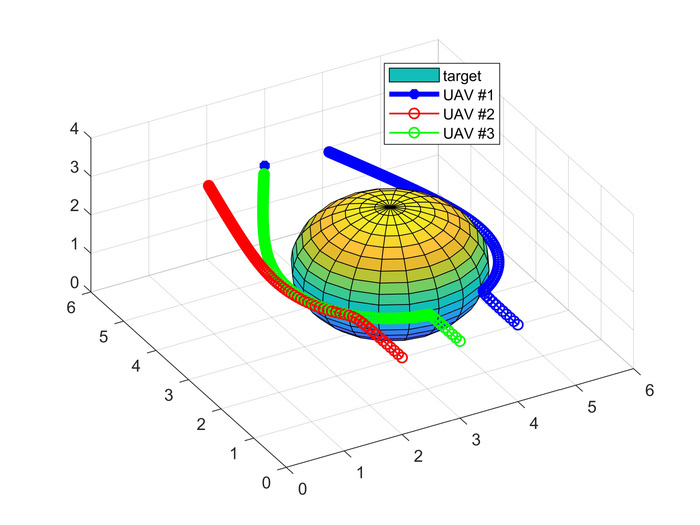 장애물 회피 MATLAB 시뮬레이션 (UAV 3대)
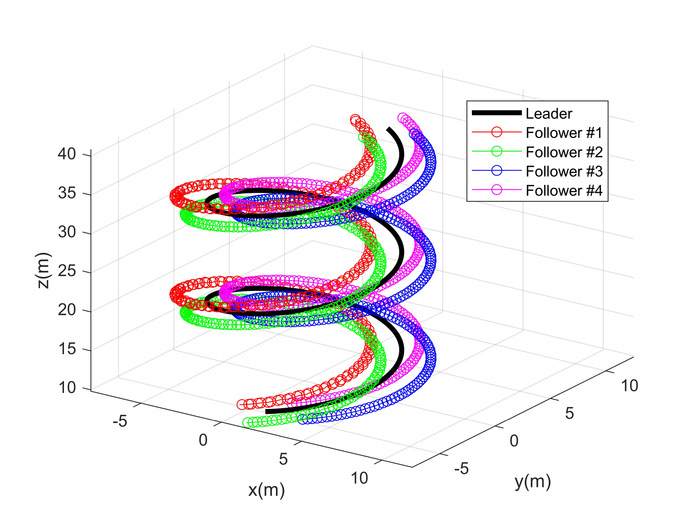 포메이션 유지 MATLAB 시뮬레이션 (Virtual Leader + 팔로워 4대)
실기체 검증은 UWB·IMU·GPS와 Mini PC를 탑재한 Pixhawk 기반 헥사콥터로 진행. Virtual Leader를 추종하는 팔로워 4대의 편대 비행에서 포메이션 오차 ±0.2m 이하와 빠른 수렴 특성을 확인.
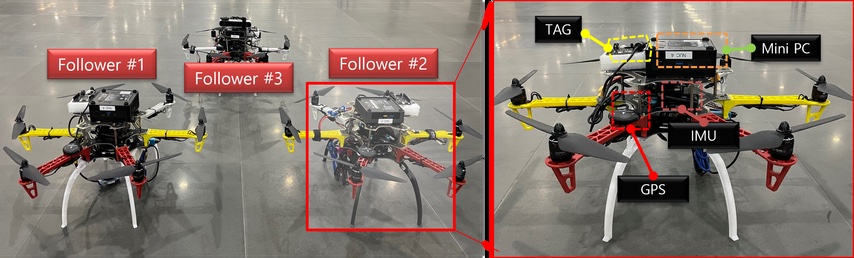 실험에 사용한 Pixhawk 기반 UAV 기체 구성 (TAG·Mini PC·IMU·GPS 탑재)
S자형 경로 추종 실험(시나리오 #1)에서는 기존 알고리즘 대비 위치 오차, 목적지 수렴 시간, 알고리즘 연산 시간이 모두 개선.
| 지표 | 기존 알고리즘 | 제안 알고리즘 | 개선 |
|---|---|---|---|
| 위치 오차 (MSE) | 0.8974 | 0.3524 | 약 61% 감소 |
| 목적지 수렴 시간 (s) | 11 | 8 | 약 27% 단축 |
| 알고리즘 평균 연산 시간 (s) | 0.044 | 0.031 | 약 30% 단축 |
포메이션 비행 시연 영상:
Multi-UAV Formation Control (NRF Anti-Drone Swarm)
Researched Multi-UAV Formation Control under the National Research Foundation of Korea (NRF) project “AI-based Cooperative Autonomous Swarm Anti-Drone System for Neutralizing Illegal Drones.” Developed a distributed controller that lets multiple unmanned aerial vehicles (UAVs) maintain formation on their own without central communication, confirming a formation error within ±0.2 m in a configuration of one Virtual Leader (a virtual reference point, not a physical vehicle) and four Followers, and achieving about a 61% reduction in position error (MSE) over the existing algorithm in an S-curve path-following experiment.
Problem
An anti-drone swarm is a system in which multiple UAVs team up to respond cooperatively to illegal drones. The difficulty: the vehicles must maintain formation without central communication, using only relative vector and distance information from neighboring vehicles. With sensor errors accumulating over longer flights, compounded by the nonlinearity of vehicle dynamics, a controller satisfying both formation keeping and collision avoidance was required.
Role
Joined the project as an M.S. student at the Advanced Control System Lab, Korea University; responsible for developing Multi-UAV cooperative control and collision-avoidance algorithms and building the hardware for validation.
Key Contributions
- Designed a distributed controller based on a Finite-Memory scheme that uses only data from a recent window, securing control performance robust to error accumulation and nonlinearity.
- Reflected the inter-follower connectivity (relative distance and angle) in cooperative navigation through a graph-based interaction topology model (Graph Model), guaranteeing the stability of dynamic formations.
- Realized decentralized cooperative control without central communication with a structure in which Followers track a common virtual target point (Virtual Leader) instead of a physical leader vehicle.
- Developed a collision-avoidance algorithm for avoiding obstacles during formation flight and verified it in MATLAB simulation.
- Built hexacopters based on Pixhawk (an open-source flight controller) equipped with UWB for inter-vehicle relative distance measurement and an IMU, and validated the algorithms on real vehicles in a ROS environment.
Results
The algorithms were first verified in MATLAB simulation. After confirming that obstacle avoidance and Virtual Leader-tracking formation keeping behaved as intended, the work was extended to real-vehicle experiments.
Obstacle avoidance MATLAB simulation (3 UAVs)
Formation keeping MATLAB simulation (Virtual Leader + 4 Followers)
Real-vehicle validation was carried out with Pixhawk-based hexacopters carrying UWB, IMU, GPS, and a Mini PC. In formation flight of four Followers tracking a Virtual Leader, a formation error within ±0.2 m and fast convergence were confirmed.
Pixhawk-based UAV configuration used in the experiments (TAG, Mini PC, IMU, and GPS onboard)
In the S-curve path-following experiment (Scenario #1), position error, destination convergence time, and algorithm computation time all improved over the existing algorithm.
| Metric | Existing algorithm | Proposed algorithm | Improvement |
|---|---|---|---|
| Position error (MSE) | 0.8974 | 0.3524 | About 61% reduction |
| Destination convergence time (s) | 11 | 8 | About 27% shorter |
| Average algorithm computation time (s) | 0.044 | 0.031 | About 30% shorter |
Formation flight demonstration video: